Video Sales Letter Best Practices for 2026 Funnels
Most "best practices" lists for video sales letters could have been written in 2019, because they were. Meanwhile the ground moved: browsers force your video to start silent, AI made producing an average VSL nearly free, and the pixel that used to report your conversions now misses a meaningful share of them. Best practices that ignore those three facts are decoration.
This is the 2026 version, organized the way the work actually happens: script, production, page, tracking, measurement. Every practice is specific enough to act on this week, and the whole thing compresses into a checklist at the end you can run before any launch.
The VSL best practices that matter in 2026: script on the eight-beat spine with a hook chosen for your audience, ship the simple version with captions always on, give the video a one-job page, track server-side with your payment processor as the source of truth, and iterate against the retention curve, worst cliff first. The winners are not the prettiest videos; they are the tightest feedback loops.
What changed for VSLs in 2026?
Three shifts define the year. Sound-off is the default start everywhere, so the hook must work silent. AI collapsed the cost of producing average video, flooding feeds and raising the bar for specificity. And browser privacy plus ad blockers keep eating client-side tracking, making server-side events the difference between an ad account that learns and one that guesses.
None of this dented demand. According to Wyzowl's 2026 video marketing survey, its twelfth year of data, 91% of businesses use video as a marketing tool and 85% of people say video content has convinced them to buy. Buyers want to be sold by video more than ever; they are just harder to hold, harder to track, and drowning in mediocre attempts.
Average is free now. The AI flood did not kill the VSL; it killed the excuse that yours is fine.
What are the script best practices?
Build on the eight-beat spine: hook, problem, mechanism, proof, offer, price framing, guarantee, close. Choose the hook pattern by audience temperature, not by taste. Make one claim you can prove rather than five you cannot. And write for a viewer who arrived mid-scroll, not one who asked to be here.
- Spine first, length last. Write until the argument is complete, then cut everything that will not hold retention. The spine survives at 8 minutes and at 50.
- Pick the hook like an operator. There are fourteen hook patterns in four families; cold traffic usually needs Identity or Tension, retargeting earns Story. Test families against each other before polishing lines.
- Claims carry receipts. Every number in the script gets a source you could show a compliance reviewer. Unsubstantiated claims are how ad accounts die.
- Write the silent 30. The first half minute must work with the sound off: on-screen text, captions, a visual promise. The unmute is earned, not assumed.
What are the production best practices?
Ship the simple version first: slides, a decent microphone, captions burned in or player-rendered. Production polish is a multiplier on an argument that already works and a tax on one that does not. Spend on audio before video, captions before b-roll, and pacing before everything.
The order of spend matters because of what each element does to retention. Bad audio loses viewers who would have tolerated plain visuals. Missing captions lose every muted-autoplay viewer at the hook, which is most of them on mobile. Slow pacing loses everyone else: cut the throat-clearing, tighten the gaps, and keep something changing on screen every few seconds. Only after the curve says the argument holds does a studio shoot earn its budget, and even then, test the polished version against the ugly one instead of assuming. The founder-made original has beaten the agency remake often enough in this industry to keep everyone honest.
What are the page and embed best practices?
One column, one video, one button. Headline restates the hook's promise, the player sits above the fold at full width, the CTA appears when the pitch has earned it, and navigation does not exist. Embed a player built for direct response, correctly, per platform.
The page is a frame, and frames should be boring. Strip the nav on the VSL step, keep testimonials below the CTA, and resist the second offer. Platform mechanics have their own guides: embedding in ClickFunnels covers the HTML/JS element and the staging test, and embedding in GoHighLevel covers the double-audio trap that catches nearly every agency once. If you gate the video for leads, place the gate after value per the play gates framework: never before the hook has proven anything.
What are the tracking best practices?
Three rules: forward conversion events server-side so ad blockers and iOS privacy stop eating them, keep event names stable through every player or page change, and treat the payment processor, not the pixel, as revenue truth. The ad platform optimizes on what it sees; feed it everything.
This is the least glamorous section and the most expensive to skip. Browser pixels undercount VSL conversions, which means an unmodified setup underreports your winners and the algorithm spends away from them. The fix is structural, not heroic: server-side pixel forwarding from the player, deduplicated against whatever browser events survive, with watch milestones and a CTA-reached event tied to real timestamps. And when you change platforms or players, protect event continuity first: renaming events mid-flight resets what the account has learned, which is the quiet killer covered in the migration guide.
How do you measure and iterate like an operator?
Watch four numbers: 30-second retention, midpoint retention, revenue per viewer, and cost per qualified view. Read them against the second-by-second curve, fix the single worst cliff, re-ship, repeat. One fix per cycle, hook first, and scale only when revenue per viewer beats what a qualified view costs.
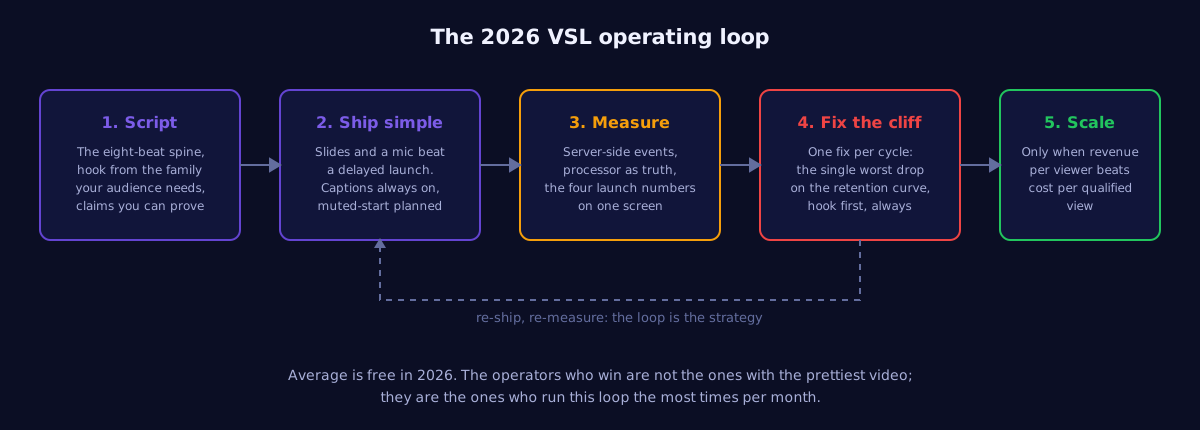
The detail lives in the cluster: the four numbers that matter defines the metrics and their benchmarks, and the heatmap guide covers reading attention peaks, drop-off cliffs, and rewatch spikes as script diagnostics. The best practice on top of both is restraint: change one thing per cycle. Fix the hook and the price section in the same edit and the curve cannot tell you which one worked.
The 2026 pre-launch checklist:
1. Script follows the eight-beat spine; every claim has a source.
2. Hook chosen from a family that fits the traffic temperature.
3. First 30 seconds work with the sound off; captions on.
4. Page has one column, one video, one button, no nav.
5. Embed tested on staging: mobile width, autoplay behavior, no double audio.
6. Watch milestones, CTA-reached, and purchase events firing server-side with stable names.
7. Revenue reconciles against the processor, not the pixel.
8. Gate (if any) placed after value, with a measurement plan.
9. Retention dashboard open before the first paid click.
10. One-fix-per-cycle iteration rule agreed in advance.
Run the loop with real instruments
VSLStats gives you the retention curve, the four launch numbers, play gates, and server-side pixels in one player. Try any plan for $1.
Start $1 Trial →