Play Gates: When They Lift VSL Conversions and When They Kill Them
Gate your VSL and your lead count jumps while your watch count collapses. Leave it open and everyone watches, nobody is contactable, and your follow-up sequence mails an empty room. The play gate is the only element in a video funnel that can be the best and the worst decision in the same account, depending on nothing but where you put it and who you point at it.
Most advice on gating comes from content marketers optimizing lead volume for a sales team. A video sales letter plays a different game: the video itself is the closer, and every gate you add is a toll booth on the road to your own checkout. This is the operator's decision framework: what a gate actually changes, when it pays, when it quietly costs you five figures a month, and how to prove which one is happening to you.
A play gate lifts VSL conversions when the video has already delivered value and the next step needs identity: lead follow-up, a booked call, a high-ticket application. It kills conversions when it stands between cold traffic and an unproven hook, or guards a low-ticket offer that should sell directly. Placement on the timeline and a measured holdout decide which one you are running.
What is a play gate on a video?
A play gate (also called an email gate, turnstile, or in-video opt-in) is a form inside the video player that pauses playback until the viewer acts, usually by submitting an email. A hard gate blocks the video until completion; a soft gate offers a skip. Direct-response players like VSLStats, Vidalytics, and Wistia all ship some version of it.
Mechanically it is simple: at a timestamp you choose, the player interrupts playback and presents a form. What makes it strategically interesting is what it converts: anonymous attention into a contactable person, mid-argument. The viewer has seen exactly as much of your pitch as you chose to show before the ask, which means the gate's position is not a detail. It is the entire strategy.
Gates also do quieter work. A submitted gate ties the rest of that session to an identity, which means watch depth, rewatches, and the eventual purchase all connect to a real lead record in your CRM. On a video sales letter, where the whole funnel often lives inside one page, that identity thread is what makes revenue attribution per lead possible at all.
What does a play gate actually change in your funnel?
A gate trades reach for identity. Ungated, you maximize the number of people who hear the full pitch and buy today. Gated, you deliberately lose some watchers to gain a list you can sell to for months. The gate moves your ruling metric from revenue per viewer to revenue per lead, and that switch should be a choice, not an accident.
Think of it as choosing which asset the campaign builds. The ungated VSL builds today's cash: every viewer who survives to the close can buy right now. The gated VSL builds a pipeline: fewer complete views, but every serious prospect becomes an email address, a retargeting profile, and a follow-up sequence entry. Neither is free. The ungated version wastes the overwhelming share of viewers who leave without buying or identifying themselves. The gated version taxes every single viewer, including the ones who would have bought.
A play gate does not create demand. It bills the demand your video already created, and the bill arrives at whatever timestamp you choose.
That framing kills the most common gating mistake on sight: putting the toll booth before the road has gone anywhere. A gate at second five is billing demand that does not exist yet.
When does a play gate lift VSL conversions?
Gates pay when three things line up: the video has already delivered its teach (the viewer got value), the offer closes off-video (a call, an application, a demo), and the follow-up machine actually exists. High-ticket coaching, agencies, and B2B-ish offers with sales calls are the natural fit. The gate collects the qualified; the video did the qualifying.
The placement evidence points the same direction. According to Wistia's gated-video data from its own library, forms in the final quarter of hour-plus videos converted around 75% of the viewers who reached them, while the same report shows an ask that arrives too early can drop completion to roughly 5%. Their library skews toward content video rather than direct-response VSLs, so treat the shape as the lesson, not the digits: gates convert when they arrive after value, late enough that the people still watching have self-selected into seriousness.
The strongest specific setups I would gate without hesitation:
- The teach-then-turn VSL. Course creators and coaches whose video teaches for the first half. Gate at the turn, right after the mechanism lands. Viewers who just got value reciprocate, and everyone who leaves was not buying a $2,000 program anyway.
- Call-booked offers. When the CTA is a calendar, the gate is barely a gate; it is step one of booking. Route straight from form to scheduler and follow up the same day, while the pitch is warm.
- Warm traffic on a high-ticket pitch. Your list, your community, your retargeting pool watching a serious offer. These are the highest-quality leads you will ever collect. Gate mid-video with confidence.
- Second-chance capture. A soft gate late in the video, offering the recap, the PDF version, or the case study. It monetizes viewers who are interested but not ready, without blocking anyone.
When does a play gate kill your VSL?
Gates kill when they demand identity before the video has earned it, or when they interrupt a purchase that would have happened anyway. Upfront gates on cold paid traffic, any gate on a low-ticket impulse offer, and hard gates shown to returning buyers are the three ways operators quietly tax their own checkout.
- The upfront gate on cold traffic. A stranger clicked an ad thirty seconds ago and you are already asking for their email. The hook has proven nothing; the exchange rate is terrible. Most bounce, and the ad platform learns your funnel bores people.
- Gating a direct-checkout offer. If the VSL sells a $47 or $197 product with a buy button, every gated second is friction between a persuaded viewer and your cart. Collect identity at checkout, where it belongs, and use watch-depth audiences for the ones who left.
- Over-asking. Name, email, phone, company size, revenue band. Every field is a fee. Serious lead qualification belongs on the application page, not inside the player.
- Hard-gating the already-known. Returning visitors and list members hitting the same wall they already passed reads as broken, not strategic. Suppress the gate for known viewers if your player allows it.
The pattern behind all four: the gate extracts a cost the argument has not yet covered. Watch your own funnel for it; on a retention curve an early gate shows up as a vertical cliff at the gate timestamp, exactly like a failed hook, because to the viewer it is one.
Where on the timeline should the gate go?
Never before the hook has proven value. On cold traffic the earliest defensible spot is the turn, right after the mechanism section delivers the teach. Skippable soft gates can sit there; hard gates belong late, at the offer or in the final quarter, where only genuine buyers remain and the form is effectively step one of purchase.
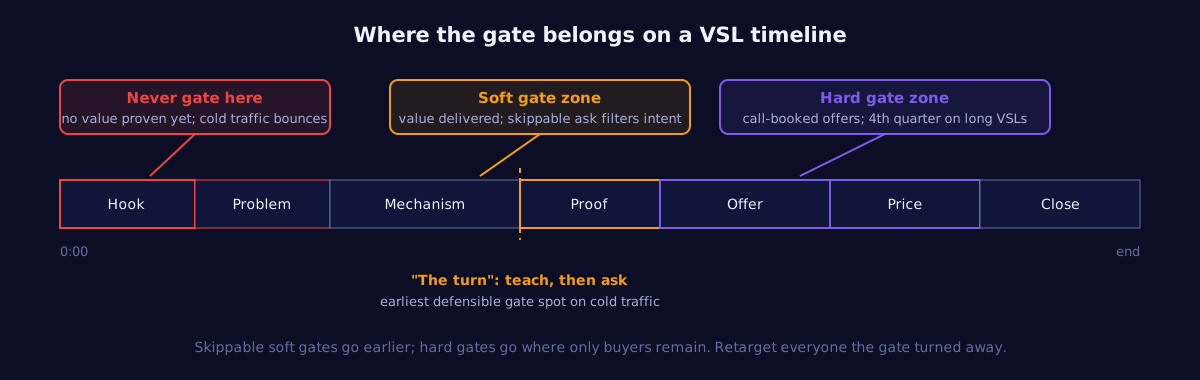
Two refinements on top of the zones. First, match gate hardness to distance: the further right on the timeline, the harder the gate can be, because the audience remaining is progressively more qualified. A skippable ask at the turn, a firm ask at the offer. Second, use your own engagement heatmap to place the gate after a peak, not during one: interrupting a rewatch spike (a moment viewers found valuable enough to replay) converts better than interrupting a slog.
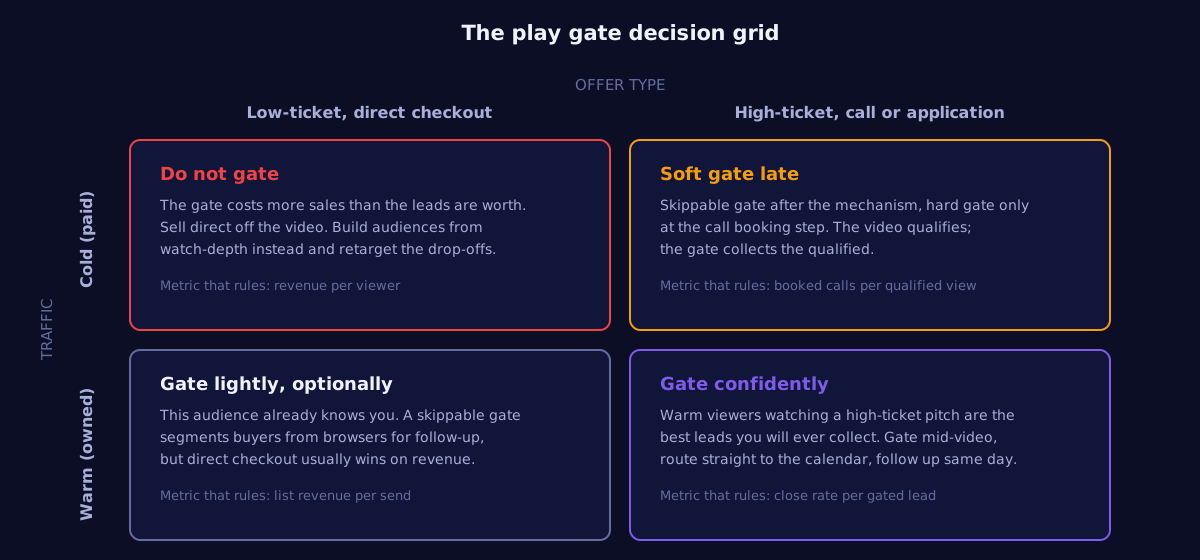
Traffic and offer type set the strategy before timing does. The grid:
How do you prove your gate is paying?
Run an ungated holdout and compare total revenue per viewer, not lead count. Track four gate numbers: reach rate (share of starters who hit the gate), completion rate (submits among reachers), post-gate retention, and downstream revenue per gated lead. A gate that wins on leads and loses on total revenue is a decoration, not a strategy.
The holdout is the part everyone skips. Split traffic between the gated VSL and an identical ungated version, give the ungated arm honest follow-up via retargeting, and let both run long enough for the follow-up sequence to do its work. Then compare full-window revenue per viewer. Gates front-load pain and back-load payoff, so a seven-day read will slander a gate that a sixty-day read vindicates. Decide on the window your sales cycle actually runs.
The four gate numbers tell you what to fix while the holdout tells you whether to gate at all. Low reach rate: the video is losing people before the gate, which is a script problem, and the four launch numbers will localize it. Low completion: the gate arrived before value or asks for too much. Post-gate retention cratering: the gate is attracting completions from people who wanted the content, not the offer; move it later or soften the promise. Weak revenue per lead: the follow-up machine, not the gate, is the leak.
Wire the events server-side while you are at it. Gated funnels live and die on attribution, and browser pixels drop a meaningful share of form and purchase events; that is why your Meta pixel undercounts VSL conversions. If the gate feeds your ad algorithm bad lead data, it optimizes toward the wrong strangers.
Gate on evidence, not vibes
VSLStats gives you play gates with timestamp control, per-second retention around the gate, and revenue attribution per gated lead. Try any plan for $1.
Start $1 Trial →