The 14 Hooks That Actually Open a VSL (With Real Examples)
Nobody skips a video sales letter at minute twelve. They skip at second eight. Whatever you spent on the script, the offer, the editing, and the traffic, all of it is judged in the first half minute by a stranger with a thumb hovering over the back button. That is the hook's territory, and it is the most expensive thirty seconds in direct response.
Most hook advice is a pile of examples with no system, so you copy one that worked for a supplement offer and wonder why it dies for your SaaS. This is the system: fourteen hook patterns, sorted into four families by the job they do, each with the situations it fits, a real example where a famous one exists, and the retention signature that tells you whether it is working on your traffic rather than in theory.
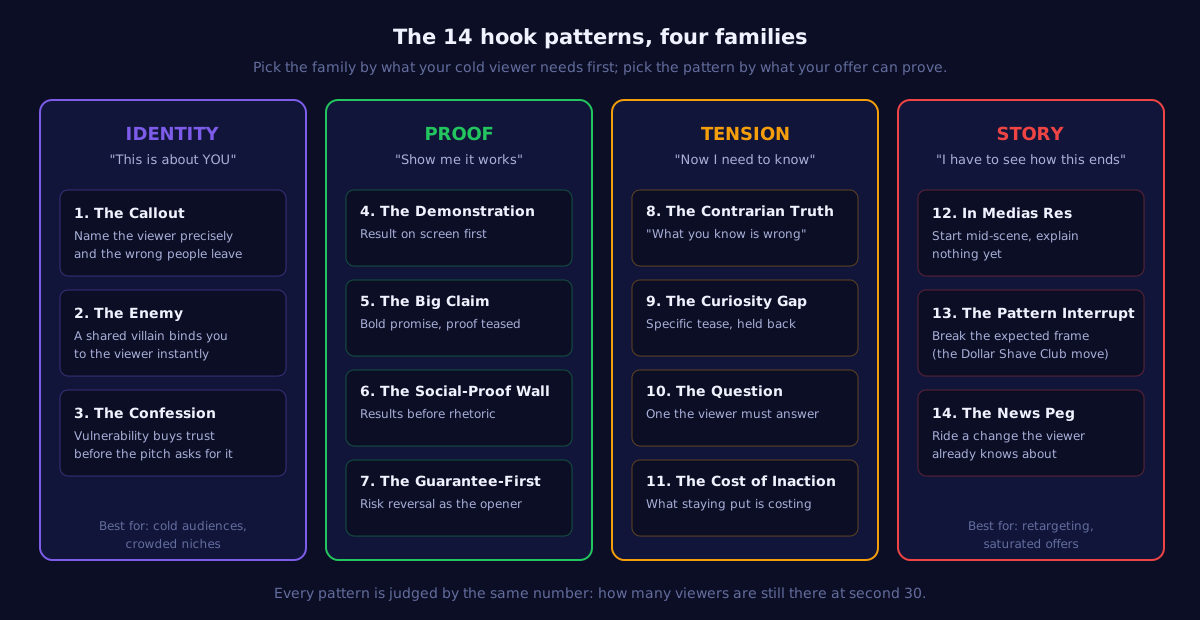
A VSL hook has one job: earn the next minute of a stranger's attention. The fourteen patterns that reliably do it fall into four families: Identity hooks that name the viewer, Proof hooks that show the result, Tension hooks that open a gap the viewer needs closed, and Story hooks that start mid-scene. Pick the family by what your cold viewer needs first; judge the result by 30-second retention, never by how clever it sounds.
What makes a VSL hook actually work?
Three moves inside 30 seconds: filter (the right viewer thinks "this is for me"), promise (a specific reason to keep watching), and tension (an open loop that watching resolves). A hook can be ugly, quiet, or strange and still work; it cannot be vague. Vague is the only unforgivable sin at second eight.
The hook is not the branding moment and it is not the pitch. It is a toll gate where the viewer pays attention (literally) in exchange for a reason. That is why hooks are judged by one number: the share of starters still present at second 30. Our launch metrics guide benchmarks 60 to 75 percent for cold paid traffic, and the diagnosis rule is blunt: below roughly 55, nothing downstream matters yet. Fix the toll gate before redecorating the road.
The hook is not part of the video. It is the price of admission to it, and cold traffic pays in seconds, not dollars.
What are the four hook families?
Identity ("this is about you"), Proof ("show me it works"), Tension ("now I need to know"), and Story ("I have to see how this ends"). Identity earns trust from cold audiences, Proof suits offers with demonstrable results, Tension revives saturated markets, and Story carries retargeting and long-form pitches.
How do the Identity hooks work?
Identity hooks make the right viewer feel seen before anything is sold. They trade reach for resonance: the wrong people leave early (which is fine, they were never buying) and the right people lean in because the video is visibly about them.
- 1. The Callout. Name the viewer with uncomfortable precision: not "business owners" but the specific operator with the specific problem at the specific stage. Fails when the callout is broad enough to be nobody. Retention signature: a sharp early drop that then flattens beautifully; you filtered, which was the point.
- 2. The Enemy. Open on the shared villain: the platform eating your margins, the industry practice everyone hates, the advice that keeps failing. A common enemy creates instant alliance. Fails when the villain is a strawman your viewer does not actually resent.
- 3. The Confession. Start with the embarrassing truth: the launch that flopped, the money lost, the thing you got wrong for years. Vulnerability buys trust before the pitch spends it. Fails when the confession is humble-bragging in a trench coat.
How do the Proof hooks work?
Proof hooks put the result on screen before the argument starts. They fit offers with visible, demonstrable outcomes, and they carry a discipline tax: every claim shown in second five gets substantiated later, or the refunds and the ad account pay for it.
- 4. The Demonstration. Show the thing working before explaining anything. The oldest move in direct response for a reason: seeing beats hearing. Fails when the demo needs context the viewer does not have yet.
- 5. The Big Claim. One bold, specific, falsifiable promise plus a tease of the proof to come. Specificity is what separates it from hype: a precise claim reads as confidence, a round one reads as marketing. Fails without receipts, loudly.
- 6. The Social-Proof Wall. Open on results: screenshots, counts, faces, names (real ones only; fabricating any of this is how offers die). Works when your market already wants the outcome and just doubts you. Fails on genuinely novel offers where the viewer does not yet want the thing your proof shows.
- 7. The Guarantee-First. Lead with the risk reversal: "watch to the end, and if you do not think X, here is what I will do." Rare, pattern-breaking, and it forces you to have a guarantee worth leading with. Fails when the guarantee has asterisks.
How do the Tension hooks work?
Tension hooks open a gap between what the viewer believes and what you are about to show, and the discomfort of the open gap holds attention. They are the strongest family for saturated markets where every viewer has seen ten pitches like yours this week.
- 8. The Contrarian Truth. "Everything you have been told about X is backwards, and it is costing you Y." Earns attention by attacking consensus. Fails when the contrarianism is fake: if your "secret truth" is the same advice in a new hat, the mechanism section collapses and the curve shows it.
- 9. The Curiosity Gap. Tease something specific and hold it: "the three-word question that killed our best-performing ad." Specific beats mystical; the gap must be narrow enough to feel answerable. Fails when the payoff arrives too late, which reads on the curve as a slow bleed of betrayed patience.
- 10. The Question. Ask the one question the viewer cannot help answering in their head. A question converts a spectator into a participant. Fails when the answer is "no" for most of your traffic; a question hook is a callout in disguise, so aim it.
- 11. The Cost of Inaction. Quantify what staying put costs: the leads leaking, the hours burned, the compounding gap between the viewer and the people who moved. Fails when it tips into doom; stakes hold attention, despair loses it.
How do the Story hooks work?
Story hooks borrow the oldest attention technology there is: an unresolved scene. They suit longer VSLs, retargeting audiences who already know the offer, and founders with a genuine story. Their retention curves are distinctive: slower early drop, deeper average watch, and everything depends on the story actually connecting to the pitch.
- 12. In Medias Res. Start mid-scene, explain nothing: the moment the account got banned, the refund email that started it all. The viewer's need for context does the holding. Fails when the scene is generic; "I was at my lowest point" is a scene nobody can picture.
- 13. The Pattern Interrupt. Break the expected frame entirely. The canonical case is Dollar Shave Club's 2012 launch video: a founder deadpanning that his blades are (censored) great, riding a warehouse chaos tour, in a category that advertised with chrome and swooshes. The ad is widely credited with launching the company that Unilever later bought for a reported billion dollars. The lesson is not "be funny"; it is "be the opposite of what the category trained the viewer to expect." Fails when the interrupt has nothing to do with the offer: attention without relevance is a magic trick, not a hook.
- 14. The News Peg. Open on a change the viewer already knows about (a platform policy, a price shift, an AI release) and make the video the response to it. Borrowed urgency, honestly used. Fails when the peg is stale or the connection is forced; and it ages, so date-stamp your expectations for the asset.
How do you test hooks without fooling yourself?
One variable, one number, enough traffic. Swap only the first 30 seconds between variants, keep everything downstream identical, and read 30-second retention per variant against revenue per viewer. A hook that holds more viewers but attracts the wrong ones shows up as retention up, revenue flat: the callout is aimed wrong, not the writing.
The mechanics matter less than the discipline. Test hooks head-to-head rather than sequentially (traffic quality drifts week to week), give each variant enough viewers that the difference is not noise, and watch the engagement heatmap around the transition from hook to body: a spike of rewinds at the handoff means the hook promised something the body opens too slowly to deliver. And because hook tests live or die on event data, make sure the viewership itself is measured server-side; browser pixels undercount, and a hook test on partial data is a coin flip with charts.
The practical cadence that works: write three candidates from three different families (not three variations of one line), ship the ugly versions, kill the losers at the 30-second mark, then iterate lines inside the winning family. Families first, words second. The family decides who stays; the words decide how it feels.
Let the curve pick your hook
VSLStats shows 30-second retention, the hook-to-body handoff, and revenue per viewer for every variant you test. Try any plan for $1.
Start $1 Trial →