What Is a VSL? Video Sales Letters Explained by an Operator
Ask Google or ChatGPT what a VSL is and most of what comes back was written by content teams at generalist video tools. The definitions are accurate the way a dictionary is accurate. They can tell you the acronym. They cannot tell you what it feels like to watch a retention curve fall off a cliff at the exact second your price appears on screen, or why an ugly slideshow with a voiceover keeps beating videos that cost fifty times more to produce.
I run video sales letters and I build the analytics that measure them, so this is the practitioner version. What the format actually is, where it came from, what separates it from every other kind of marketing video, what goes into a script that holds attention, and the numbers that tell you whether yours is doing its one job: selling.
A video sales letter (VSL) is a video whose entire job is to sell one offer from start to finish: hook, problem, mechanism, proof, price, close. It lives on a dedicated page with a single call to action, runs anywhere from five minutes to over an hour, and unlike brand or explainer video it is judged like a salesperson: on revenue per viewer, not views.
What is a video sales letter (VSL)?
A VSL is a scripted sales presentation delivered as video, usually on a landing page with one button under it. It is the direct descendant of the long-form written sales letter from direct mail. The viewer is walked through problem, mechanism, proof, and offer in one sitting, and the page exists for exactly one conversion event.
The anatomy is deliberately minimal. One page. One video, often with a delayed or timed call to action that only appears once the pitch has earned it. No navigation to wander off into, no related videos, no comment section. Everything about the environment is built to keep one argument running from first second to final ask.
You will find VSLs wherever direct response lives: info products and online courses, coaching and consulting offers, supplements and health brands, financial publishers, software trials, and high-ticket ecommerce. What those businesses share is an offer that needs explaining and a buyer who needs persuading. A product that sells on sight does not need a VSL. A product that sells on understanding almost always converts better with one.
The "letter" in the name is not decoration. Before video, direct-response companies mailed sales letters that ran ten, twenty, forty pages, because longer arguments closed more expensive products. The VSL took that letter, put it on screen, and added the two things paper never had: a voice, and a clock. The clock is the part most people underestimate. A written letter lets the reader skim to the price. A VSL controls the order in which the argument arrives.
Where did the VSL format come from?
The VSL descends from the direct-mail sales letter. Copywriter Jon Benson is generally credited with creating the format in the mid-2000s, when he turned a written pitch into a plain PowerPoint video: black text on a white screen, read aloud. According to Benson's own telling, that ugly version outsold his polished video by roughly 600%.
The origin story, as Benson has told it, is that the first version was nothing more than slides with highlighted trigger words and a five-minute voiceover. No presenter, no b-roll, no motion graphics. According to the same telling, it converted around 1% at first, and a longer eighteen-minute cut lifted conversions to 6.1%. The industry took two lessons from that. First, video could carry a full sales letter. Second, and more uncomfortable for the production industry: polish was not the active ingredient.
Text-on-screen worked because it forced linear consumption. Viewers read and heard the argument simultaneously, could not skim ahead to the price, and stayed inside the sequence the copywriter designed. Twenty years later the format has grown presenters, studio shoots, AI voiceovers, and AI-generated everything, but the spine has not moved. The argument is still the product.
Production value is a tiebreaker between two VSLs with the same argument. It has never once rescued a VSL with the wrong one.
How is a VSL different from other marketing videos?
A brand video builds recall, an explainer builds understanding, and a webinar teaches before it pitches. A VSL sells the whole time. It is longer than an ad, more direct than an explainer, and always paired with an immediate purchase or booking action on the same page.
| Video type | Primary job | Typical length | Where it lives | The number that judges it |
|---|---|---|---|---|
| VSL | The sale itself | 5 to 60+ minutes | Dedicated page, one CTA | Revenue per viewer |
| Brand film | Recall and affinity | 30 to 90 seconds | Social, pre-roll | Reach and recall lift |
| Explainer | Comprehension | 1 to 3 minutes | Homepage, product page | Demos and signups |
| Webinar | Teach, then pitch | 45 to 90 minutes | Registration funnel | Show-up and close rate |
The deeper difference is the viewer. VSL traffic is usually bought, cold, and impatient. Nobody subscribes to a VSL. A stranger clicked an ad ninety seconds ago and is deciding, second by second, whether your argument deserves more of their evening. That is why VSL people obsess over hooks, retention curves, and drop-off timestamps in a way brand marketers never need to.
What does a VSL script actually contain?
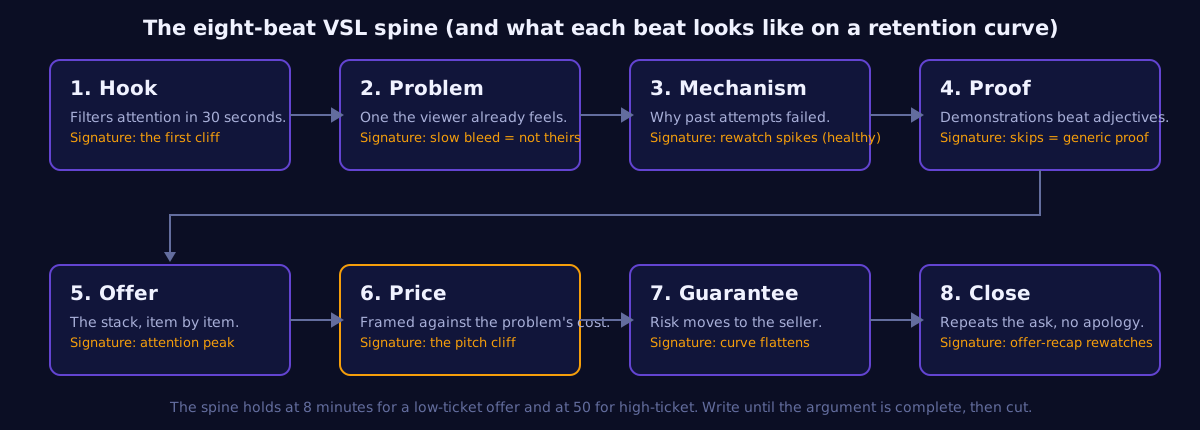
Nearly every converting VSL follows the same spine: a hook that filters attention in the first 30 seconds, a problem the viewer already feels, a mechanism that explains why past attempts failed, proof, the offer stack, price framed against the cost of the problem, a guarantee, and a close that repeats the ask without apology.
Each beat also has a measurable signature, which is the part generic explainers never mention. When you put a script against a retention curve, the failures localize:
- The hook (first 30 seconds). The first cliff. If a large share of viewers is gone before second 30, nothing downstream matters yet. Fix the hook before touching anything else.
- Problem and agitation. A slow bleed here means you are describing a problem the viewer does not recognize as theirs, or taking too long to get to why it persists.
- The mechanism. The "why everything you tried failed" section. Rewatch spikes here are common and healthy: viewers rewind to process a new idea.
- Proof. Testimonials, demonstrations, data. Skips through this section usually mean the proof is generic, not that proof is unnecessary.
- The offer and price. The pitch cliff. Some drop at the price reveal is normal; a vertical wall means the value framing before it failed, or the price arrived before the argument earned it.
- Guarantee and close. Viewers who reach this section are buyers deciding. Rewatch activity on the offer recap is a buying signal worth gating and retargeting.
A VSL is not a video that happens to sell. It is a sales argument that happens to be a video, and every second is either building the case or losing the jury.
Length is a downstream decision. The spine holds at eight minutes for a $47 impulse offer and at fifty minutes for a $5,000 coaching program. You are not writing to a duration; you are writing until the argument is complete, then cutting everything that does not hold retention.
Do VSLs still work in 2026?
Yes. Wyzowl's 2026 video marketing survey, its twelfth year of data, found 91% of businesses use video as a marketing tool and 85% of people say video has convinced them to buy a product or service. What died is the lazy version of the format: unmeasured, unhooked, autoplaying into silence.
The demand side has never been friendlier to video-first selling. The same Wyzowl survey found 63% of consumers prefer short video when learning about a product, against 12% who prefer text. Buyers have voted. The question is not whether video sells; it is whether your particular thirty minutes of it does.
The delivery environment, though, got harder in three specific ways:
The 2026 reality check for VSL operators:
1. Sound-off is the default. Browsers restrict autoplay with audio, so your first seconds run muted. Captions stopped being accessibility polish and became the hook's delivery vehicle.
2. Browser pixels undercount. Ad blockers and iOS privacy features eat a meaningful share of conversion events, which is why your Meta pixel undercounts VSL conversions and why server-side tracking became table stakes.
3. AI flooded the average. Generating a mediocre VSL now costs almost nothing, which pushed the floor down and the ceiling up. Distribution rewards the operators who measure and iterate, because the merely-average is everywhere.
Honesty requires the other half: VSLs are the wrong tool for some products. Impulse-priced ecommerce that sells on a photo does not need a twenty-minute argument. Enterprise B2B with a six-person buying committee will not purchase off a landing page video. The format earns its keep where a considered, explainable, individually-purchasable offer meets cold traffic. That is a large territory, and it is exactly the territory where measurement pays.
How do you measure whether a VSL is working?
Ignore play rate and total views. The numbers that predict profit are 30-second retention, midpoint retention, revenue per viewer, and cost per qualified view, all read against a second-by-second retention curve. If revenue per viewer beats what a qualified viewer costs you, scale. If not, the curve shows you which script beat to fix.
The full framework is its own piece: the four numbers that matter on a VSL launch covers the metrics and their benchmarks, and reading video engagement heatmaps covers the diagnostic side: attention peaks, drop-off cliffs, and rewatch spikes, and what each one tells you to change.
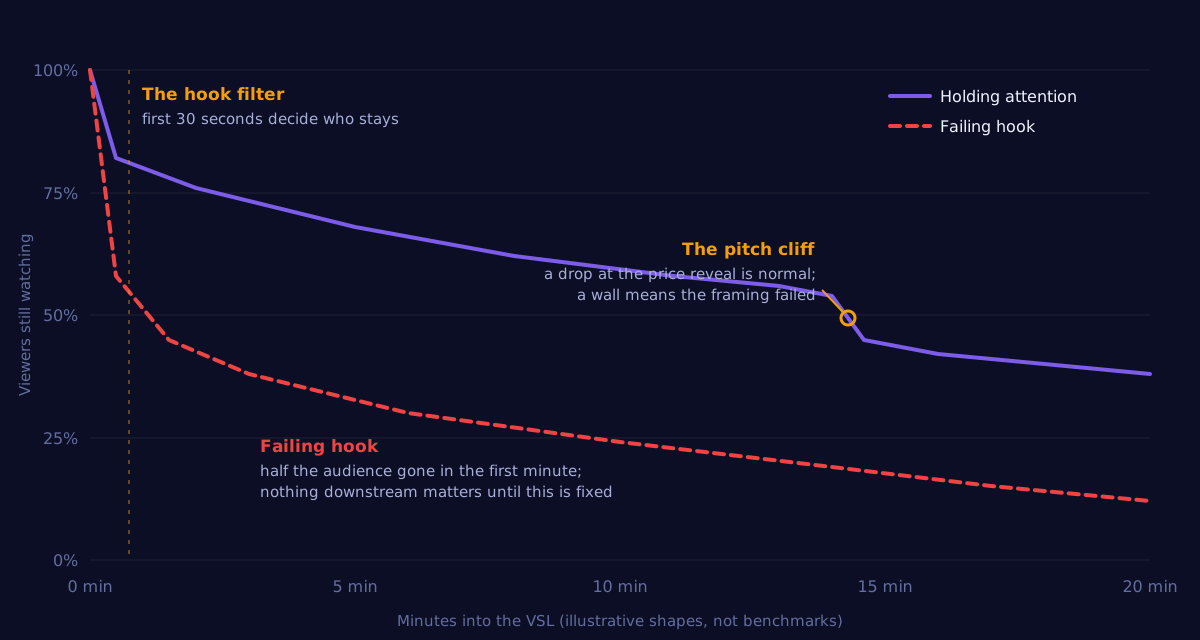
Two habits separate operators from hopefuls. First, revenue comes from the payment processor, not the pixel; browser tracking flatters nobody and lies to everybody. Second, every metric gets mapped back to a timestamp, because "conversions are down" is a mood, while "we lose half our remaining viewers in the ninety seconds after the price reveal" is a work order.
If you cannot see where viewers leave, you are not running a VSL. You are running a hope.
How do you launch your first VSL this week?
Write the script against the eight-beat spine, record the simple version with slides and a decent microphone, put it on a page with one button, and turn retention tracking on before you buy the first click. Your first retention curve will teach you more than any guide, including this one.
- Script the spine first. Hook, problem, mechanism, proof, offer, price framing, guarantee, close. Write it as a letter, then read it aloud and cut every sentence that makes you reach for the skip button.
- Ship the ugly version. Slides, highlighted key phrases, your voice. This is the founding move of the entire format, and it still converts. You are testing an argument, not auditioning for an award.
- One page, one button. No nav, no footer maze. Delay the CTA until the offer beat if your traffic is cold.
- Wire the numbers before spend. Retention milestones at 30 seconds and midpoint, a CTA-reached event, revenue per viewer from your processor. Set up server-side pixel forwarding so the ad platform actually sees your conversions.
- Buy a small test batch and read the curve. Fix the single worst cliff, re-run, repeat. Iteration against the curve is the whole game.
- Spend on production last. Once the argument holds retention, better production is a multiplier. Before that, it is expensive paint on a cracked wall.
If you want to see how the platforms stack up before you pick a player, the operator-tested rankings are in the best VSL software in 2026.
See your VSL the way buyers experience it
VSLStats shows the retention curve, the heatmap, and the revenue behind every second of your video sales letter. Try any plan for $1.
Start $1 Trial →