One VSL, Two Openers for Cold Ads and Warm List Traffic
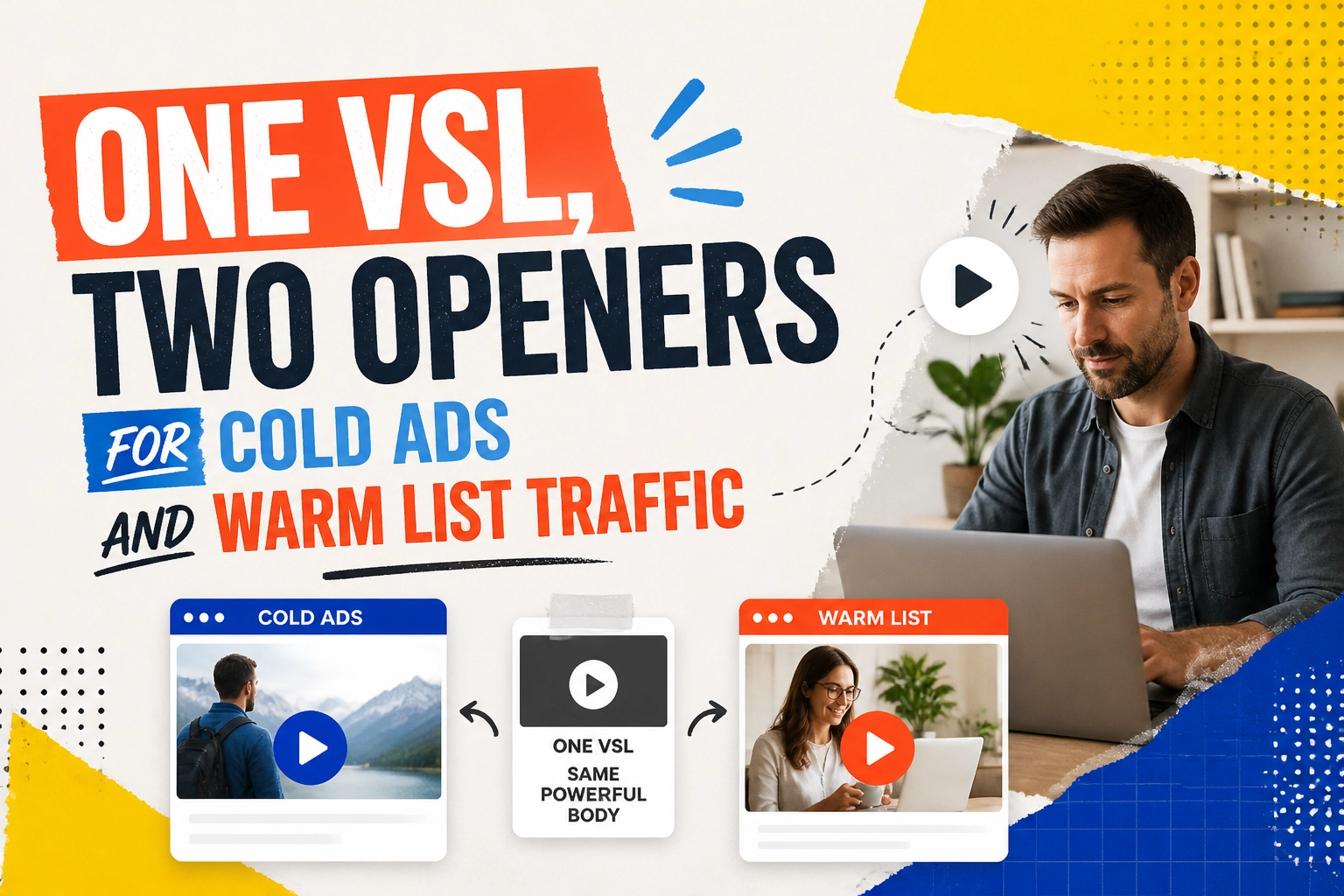
You built one VSL, so you wrote one opener. Cold paid traffic and your email list both watch it, both drop off, and your blended retention curve tells you nothing about either. That average is the problem. Cold viewers leave because they have zero context and no reason to trust you yet. Warm subscribers leave because they have already heard your setup line, maybe three times this month. One opener cannot fix both, so it usually fixes neither.
The fix is not a second video. It is a second opener over the same script body, routed by traffic source, with retention segmented and each opener judged against its own baseline. A/B split testing gets you the clean read, revenue attribution tells you which opener actually pays.
This post walks the seven-step build: a cold opener and a warm opener over one frozen body, routed by source and judged against separate baselines.
Why One Opener Serves Neither Audience
One 30-second retention figure averaged across cold paid traffic and your email list describes neither audience. The two groups arrive with different context and leave for different reasons. Media buyers already avoid this comparison error on the ad side: Elev8 Operations separates traffic-campaign clicks from lead-campaign clicks, noting they come from different objectives and that Meta shows them to different people.
Wasted opener seconds also cost more than they did a year ago. Ryze AI vendor benchmarks put 2026 average CPC at US$0.78, up 11.4%, and CPM at US$14.19, up 20.1%. That is one vendor's data, not an industry census, so treat it as a signal to check against your own account.
Write one opener and you optimize it toward whichever source dominates your mix, leaving the other audience with an opener built for someone else. The fix is structural, not a copywriting talent problem: two openers, one script body, two separate baselines, built on the same VSL script fundamentals.

Cold and Warm Viewers Leave for Different Reasons
Cold viewers exit on orientation. They do not know who you are, what you sell, or whether it applies to them, so your first seconds must answer "is this for me" before anything else earns a hearing. Warm viewers exit on redundancy. They opted in already, so "I have heard this before" is the killer, and a re-introduction reads as a stall rather than a warm-up.
Map exits to seconds. Pull drop-off second by source and label the reason at that exact line: confusion, disbelief, boredom, already-convinced.
Rewinds carry a different signal. Heavy rewinding inside the first 40 seconds suggests the claim landed and viewers wanted the detail again, which is not the same finding as a drop-off. Blended watch-time averages blur both, so read why blended watch time misleads and go per-second.
One honest limit: no public VSL-specific dataset shows exactly where cold and warm retention curves diverge. Treat this as a method to test on your own data, not a benchmark to copy.
Step 1: Lock the Body Before You Touch the Opener
With the exits mapped, the next job is to remove every variable except the opener.
Freeze the body first: same offer, same price, same proof order, same CTA, same length after the opener. Holding every other input fixed is what makes a single-variable test readable.
Define the opener boundary. No industry standard exists, so this post draws it at the first 20 to 40 seconds. You can set a different line. Mark that line in the script document so both versions pick up an identical body from the same word.
Name and version the files, for example vsl-cold-opener-v1 and vsl-warm-opener-v1, and note the identical body word count in each header to prove the body did not move. Keep a change log of what you altered and why, so a losing variant still teaches you something.
Then leave the body alone: two variables at once give you a result you cannot read. If a line is genuinely broken, tighten the draft with script analysis before launch and log the edit. Never patch the body mid-test.
Step 2: Write the Cold Opener for Zero Context

With the body frozen, write the cold opener as if the viewer has never seen your name. Assume no brand recognition, no category awareness, no trust, and no memory of your last email or ad. Cold viewers decide fast: a 2026 study found attention to nonskippable YouTube ads lasted 8.6 to 9.7 seconds. Open on the specific problem in their words, with a number, scenario, or cost, not a company positioning statement. Qualify the audience inside the first two sentences so the wrong viewers leave and the right ones lean in. Put one hard proof point early, such as a mechanism, demonstration, or substantiated result, because credibility is still in play. Cut insider language, list references, and "as I mentioned" phrasing. Every callback assumes exposure the cold viewer does not have. For evidence-led script patterns, see these data-tested VSL script examples.
Step 3: Write the Warm Opener for Familiarity Fatigue
The cold opener earns attention from scratch. The warm opener has to earn it back.
Your warm viewer already knows the offer, so the real question is not who you are but why watch this again. Front-load the answer. Open on what is new: a mechanism you have not shown before, a fresh data point, a different angle on the same problem, or a concrete reason the offer matters right now.
Acknowledge the shared context in one line so they know they landed in the right place, then move. Do not re-teach. Skip the origin story and the credentials recap unless something genuinely changed; that audience has already granted you the benefit of the doubt. Familiarity is not permission to loosen claims, though. Claim substantiation rules apply to every version you publish, and warm viewers have already heard your stronger version, so a softened number stands out.
Step 4: Route Each Audience to Its Own Opener
With both openers written, route traffic so the right version loads every time. Give paid traffic and email clicks separate landing paths or separate player versions, for example /vsl-cold and /vsl-warm, so nobody loads the wrong opener. Use consistent UTM tags for source, medium and content on every link so reporting stays clean. Before spending, click your own ad and your own email link and confirm which opener appears each time. Run that routing check against your pre-traffic checklist before launch. Keep the transition line from opener to body neutral, so both versions enter the body at the same emotional temperature and the seam stays invisible. Audit for leaks monthly: one forwarded email pointing at the cold URL will contaminate the comparison. Once routing is clean, measure retention by source.
Step 5: Segment Retention by Traffic Source
Routing is settled, so the measurement has to match it. Report five metrics per source and never pooled: 30-second retention, drop-off second, rewind rate, play rate and revenue per viewer, with cold and warm kept on separate rows. Blended figures describe an audience that does not exist.
VSLStats supplies the per-second layer this method depends on. Engagement heatmaps pinpoint the drop-off second, A/B split testing serves each opener, and revenue attribution ties watch depth to revenue by version. Run the comparison on server-side conversion forwarding: ad blockers and iOS privacy settings can hide up to 30% of conversion data from browser pixels, and a pixel-only read will misrank the two versions.
Label the reason at each cliff, not just the second. Confusion, disbelief, boredom, already convinced. A labeled drop-off becomes a line of copy to rewrite; an unlabeled one becomes a guess about the offer.
Export weekly and date every snapshot. Viewers drift as creative and list segments change, so an undated average is worthless. Track the VSL numbers that matter alongside these per-source figures.
Step 6: Judge Each Opener Against Its Own Baseline
Now build the baseline each opener is judged against. Before launch, record your current opener's numbers for that source over a fixed window: 30-second retention, completion rate, click-through to the offer, revenue per viewer.
Set the session count per variant in advance. No published benchmark exists for opener-level sample size, so require a minimum session count rather than a minimum number of enthusiastic opinions from your team. Borrow the relative logic instead: judge against your own account, not a global average.
Ignore blended averages and single-score hit rates; both hide which variant moved retention. Weight downstream metrics too. Elev8 attributes most of its home-improvement lead-cost gap to conversion rate (5.32% vs 8.54%) rather than click cost ($2.18 vs $1.80). The cheapest click is not the better script. Read what industry benchmarks miss before you set the bar.
Step 7: Kill an Opener or Keep Waiting
The rule that closes the test belongs in writing before launch. Once the session threshold is met, replace the opener if 30-second retention for that source falls below its own baseline, and hold if it is flat or better. Give the test a minimum runtime matched to your traffic volume, then close it. Open-ended tests drift with creative refreshes, seasonality and list fatigue until the result means nothing.

Agencies publishing 2026 Meta checklists advise monitoring frequency, refreshing creative before fatigue sets in, and cutting ads with a high cost per result after 72 hours. Treat that as agency advice, not a platform rule.
Diagnose before you kill. Healthy click-through and retention with weak leads point downstream to the page or form, the conversion-rate argument Elev8 makes. When you replace an opener, start from hooks that open a VSL rather than a blank page.
Decide on retention evidence inside the window. Never kill on a single-day CPC spike, and never keep on a single-day win.
Common Mistakes When Splitting Openers
The decision rule only works if the test itself is clean. Avoid these five mistakes.
Changing the whole script. If you rewrite the body and the opener together, you cannot attribute the result to either. Freeze the body; change only the opener up to the boundary you set in Step 1.
Turning the warm opener into an ad. Warm viewers already bought the premise. Cold-style qualifiers and proof stacking read as a reset, not a reason to keep watching. Lead with what is new.
Judging against a blended average. A pooled retention number is the exact error the split exists to fix. Score each opener against its own source baseline.
Launching too many variants. Four versions split the same traffic four ways and starve each of the sessions needed to clear your threshold. No variant produces a decision.
Forgetting the seam. A strong cold opener that cuts awkwardly into a warm-written body loses the viewers it just earned. Check the transition line in both versions.
FAQ: VSL Openers by Traffic Source
Most of those mistakes come from unwritten rules.
Should I use the same VSL for cold and warm traffic? Split the opener, keep the body. Offer, proof order and CTA stay identical; the opener, up to the boundary you set in Step 1, answers a different question for each audience.
How long before judging a VSL opener? Set a session threshold and runtime window before launch, then hold until both are met. No public benchmark exists for opener sample size; your own traffic volume sets the bar.
How do I attribute retention to a traffic source? Tag every link with UTMs, route each source to its own URL or player version, and read per-source 30-second retention, drop-off second and rewind rate.
Does a warm opener always beat a cold one on retention? No. Score each opener against its own source baseline, not the other opener.
Two Openers, One Body, Two Baselines
That split only works if you change one variable at a time. Freeze the body: same offer, proof order, CTA, and length after the opener. Write the cold opener for zero context, answering "is this for me" before anything else. Write the warm opener for what is new, because "I have heard this" is the exit risk. Route paid traffic and email clicks to their own URL or player version, then test both links yourself.
Segment 30-second retention, drop-off second, and revenue per viewer by source. Set each source's baseline and a minimum session threshold before launch. Judge each opener against its own source baseline, not the blended average, and use relative-baseline logic instead of a single hit-rate scorecard. After the window closes, kill or keep on retention evidence. If an opener wins but the handoff loses viewers, fix the seam before you blame the traffic.
Ready to see where each traffic source actually leaves the video? Try any plan for $1 at /pricing.
Conclusion
Your next step: freeze the body, assign a minimum session threshold per source, and launch both routes with separate links you test yourself. Then let retention evidence, not opinion, decide what stays. Ready to see where each traffic source leaves the video? Try any plan for $1 at /pricing.
Frequently asked questions
See what your VSL is really doing
Server-side pixels, AI captions, engagement heatmaps and revenue attribution - try any plan for $1.
Start your $1 trial