10 VSL Examples Worth Studying (What Each Gets Right)
Most "VSL examples" articles are a wall of embedded videos with a sentence of praise under each. Nobody tells you what any of them actually did commercially, because checking is work, and nobody tells you which part of the video to steal, because that requires having run one. This list is built differently: every example here has a documented outcome with a named source attached, and every teardown names the one device worth taking home.
One honesty rule before we start, because this niche is soaked in invented numbers: where a figure is a founder's or agency's claim, I say so and say who reported it. Where a famous stat couldn't be traced to anyone - and several couldn't - it isn't here. The videos themselves are all publicly viewable, which is the real point: this is a study list, not a highlight reel.
Ten sales videos worth studying, with documented results: Dollar Shave Club ($4,500 video, 12,000 orders in 48 hours per Inc.), Squatty Potty (600% online sales lift per Adweek), Poo-Pourri ($4M in back orders within a week per Forbes), Blendtec (700% sales growth per Inc.), Purple (158M views per Forbes), Dr. Squatch (roughly 30x to $100M+ per Forbes), Lume, Stansberry's End of America, Jon Benson's ugly VSL, and AG1's distributed funnel. Five devices repeat across all of them.
What makes a VSL example worth studying?
Three tests: the video is publicly watchable, something about its outcome is documented by a named source, and it contains at least one device you can transplant into your own script. A video that fails the second test can still teach structure - but you can't know whether the structure worked.
That second test kills most of what circulates. The direct-response world runs on results-talk, and results-talk degrades fast: an agency claim becomes a screenshot becomes a "well-known fact" nobody can source. The examples below survive because a named journalist at Inc., Forbes, Adweek, or Retail Dive put their byline on the number, or because the claim's owner is identified so you can weigh it yourself. Watch the videos, map them against the nine-section spine, and mark where each device lands on the timeline.
The demonstration era: five videos that sold with proof you can see
Dollar Shave Club, Squatty Potty, Poo-Pourri, Purple, and Blendtec built nine-figure outcomes on the same insight: a physical demonstration outsells a claim. Different tones, one pattern - the product's advantage is shown doing its job while the script names what you're seeing.
Dollar Shave Club: "Our Blades Are Great"
Documented: $4,500 production, 12,000 orders within 48 hours (founder Michael Dubin's account, reported by Inc.), and a reported $1B Unilever acquisition four years later.
The stealable device: the offer IS the hook. "For a dollar a month" lands inside the first ten seconds, and every joke after it is objection handling in disguise. Watch how the humor never wanders from the sales argument: blades, price, convenience, repeat.
Squatty Potty: the pooping unicorn
Documented: 600% online sales lift and 400% at retail per CEO Bobby Edwards as reported by Adweek; 100M+ views across platforms per Forbes.
The stealable device: the absurd mascot buys permission for a real anatomy lesson. Strip the unicorn and there's a legitimate mechanism explanation (colon angle, squat posture) - the humor exists to make the viewer sit through the physiology. Comedy carrying a mechanism, never replacing it.
Poo-Pourri: "Girls Don't Poop"
Documented: roughly $25,000 to produce, $4M in back orders within a week, and 2013 sales up 80% to just over $27M - all per Forbes' original reporting.
The stealable device: contrast as a pattern interrupt. A poised, posh spokeswoman delivering deliberately crude lines is a one-joke premise that resets attention every time it recurs - and between resets, the script quietly runs mechanism, proof, and guarantee in textbook order.
Purple: the raw egg test
Documented: 158M views across YouTube and Facebook, and first-year mattress revenue Forbes estimated past $50M.
The stealable device: the invented benchmark. The "raw egg test" is a demonstration the company made up - and it instantly made every competitor's mattress testable by a standard Purple owns. If your product wins on a measurable dimension, invent the visible test that measures it.
Blendtec: "Will It Blend?"
Documented: first five videos cost $50 total, 6M views in the first days, and home-blender sales growth of 700% per founder Tom Dickson's account to Inc.
The stealable device: the repeatable stunt format. One product claim (power), one proof ritual (blend the unbendable), infinitely rerunnable. The oldest video on this list and the clearest lesson: a format that proves the claim beats a video that states it.
The modern YouTube VSL: direct response wearing content's clothes
Dr. Squatch and Lume took the demonstration-era formula to paid YouTube pre-roll: identity-first hooks, a spokesperson who embodies the buyer or the authority, and discount-code CTAs that make the whole funnel measurable. This is the closest publicly watchable relative of the modern paid-traffic VSL.
Dr. Squatch: "Save Your Skin"
Documented: sales up roughly thirtyfold to $100M+ and 120M+ views, per Forbes (reporting figures originating with agency Raindrop); its 2021 Super Bowl follow-up drove a category-leading ~200% market-share lift per Profitero data reported by Retail Dive.
The stealable device: the identity hook. "You're a man, why is your soap made like this" filters the audience by who they are before any product claim arrives - the same move as a niche-calling VSL hook, shot in a forest. Identity first, mechanism second, discount code third.
Lume: the doctor who explains the smell
Documented: 7M+ views in weeks and "sales up 526%" - agency figures from Harmon Brothers' own release, so label them first-party. The trajectory is corroborated by Harry's later acquiring a majority stake.
The stealable device: founder-as-authority. An OB-GYN explaining odor chemistry can make claims a spokesmodel never could. If your founder holds real credentials, putting them on camera converts credentials directly into permission for stronger claims.
The long-form classics: where the VSL playbook was written
Stansberry's 77-minute End of America and Jon Benson's text-only ugly VSL defined the long-form genre: delayed offers, mechanism-heavy narratives, and runtime as a buyer filter. Study them for structure; treat every number attached to them as its owner's claim.
Stansberry Research: "The End of America"
Documented: 77 minutes long, analyzed critically by The Motley Fool at the time; 20M+ views claimed by Stansberry itself (first-party). The company never released revenue for the promotion. Context you should know before imitating anything: founder Porter Stansberry carried a 2003 SEC fraud judgment, and the campaign's fear-based claims drew heavy criticism.
The stealable device: credibility stacking before the ask. Whatever else it was, the structure is a masterclass in sequencing: past-prediction receipts first, thesis second, offer after minute 60. The delayed offer only works because the first hour is spent earning the right to make it.
Jon Benson's "ugly VSL"
Documented: almost nothing independently. Benson is widely credited in direct-response circles with inventing the text-on-screen VSL, a credit that traces to his own telling; his revenue figures ($40M letter, $1B for clients) are self-reported and unverified. The format's dominance across a decade of health and biz-opp offers is the real evidence.
The stealable device: subtraction as focus. Black text, a voice, no scrub bar, nothing else on screen - the ugly VSL is what happens when you delete everything that isn't the sales argument. Before adding production value, ask what it's covering for.
AG1: the VSL taken apart and distributed
Documented: a $1.2B valuation on a $150M bootstrapped run-rate per TechCrunch. Podcast spend figures circulating online are third-party estimates; skip them.
The stealable device: the distributed spine. AG1 runs the same sections as a VSL - trusted voice, problem, mechanism, offer - but spreads them across host-read podcast endorsements and a landing page with a founder video. Proof that the spine is the asset and the container is negotiable.
What do the winners have in common?
Five devices repeat across all ten: a filter-and-promise hook in the opening seconds, demonstration standing in for claims, a mechanism that makes the advantage feel inevitable, an identity or authority figure delivering it, and one unmissable CTA. Tone is the variable; structure is the constant.
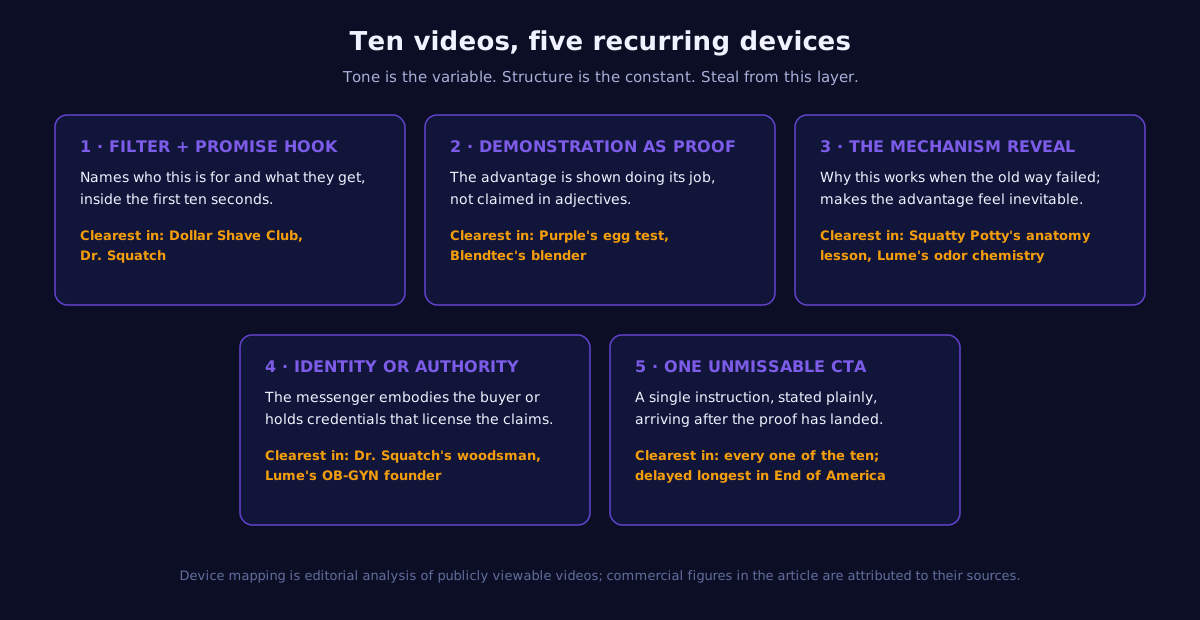
The corollary is the most common studying mistake: copying the surface. The years after Squatty Potty produced a wave of mascot videos that bombed, because imitators took the unicorn and left behind the anatomy lesson it was smuggling in. The device layer is what transfers between niches; the execution layer almost never does.
Steal the structure, not the unicorn. The joke worked once; the demonstration pattern under it works every week.
How to study any of these properly: watch with a timestamp doc open, mark where the hook ends, where the mechanism arrives, where the price lands, and which device carries each section - then compare that map against your own script's section spine and hook pattern. When you build your own, the difference between imitating and learning is instrumentation: these teams could see what held attention. The modern version of that feedback loop is covered in the VSL best practices guide, and if you're choosing where to host and measure yours, start with the platform rankings.
Frequently asked questions
Study your own VSL the way you just studied theirs
Timestamp map, retention curve, buyer watch depth: see which of your sections holds and which one leaks. Try any plan for $1.
Start your $1 trial →