Video Players with Server-Side Tracking: The 2026 Buyer's Checklist
Somewhere in 2024, "server-side tracking" crossed the line from engineering term to marketing checkbox. Every video host with a pricing page now claims it. I've sat on demo calls where the sales rep said "yes, we do server-side" and the thing being described was a browser pixel served from a different domain - which is to server-side tracking what a longer garden hose is to indoor plumbing.
If you're evaluating a video player because your Ads Manager numbers stopped matching your Stripe numbers, the phrase on the pricing page is not the thing you're buying. The implementation is. And implementations vary so much that two products with identical claims can differ by the entire gap you're trying to close. This is the checklist I'd use to buy, question by question, with what each answer should sound like. It's an evaluation guide, not a mechanics lesson - the how-it-works version lives in our server-side pixel forwarding explainer.
Before buying a video player with server side tracking, verify eight things: true server-to-server delivery (not a proxied pixel), platform coverage (Meta CAPI, GA4 Measurement Protocol, TikTok Events API), events beyond purchase, event_id deduplication, match quality parameters, PII hashing, consent handling, and a way to see it working in a trial. A vendor who can answer all eight in writing is selling plumbing. One who can't is selling a phrase.
What does "server-side tracking" actually mean in a video player?
It means the platform sends conversion and engagement events from its servers straight to the ad networks' APIs - Meta's Conversions API, GA4's Measurement Protocol, TikTok's Events API - so the events arrive even when the viewer's browser blocks the pixel. Meta describes CAPI as a connection between an advertiser's marketing data and Meta systems "from an advertiser's server, website platform, mobile app, or CRM."
The key phrase is from a server. The browser pixel still exists and still matters - it carries browser context the server can't see - but it stops being the only witness to the conversion. When the two channels run together with deduplication, the ad platform gets the union of what both saw, which is strictly more than either alone.
That's the whole concept. Everything else in this post is about the gap between that concept and what a given vendor actually shipped.
Why does this matter more in 2026 than it did three years ago?
Because the browser-only path keeps narrowing. Roughly 29.5% of internet users run ad blockers per DataReportal's Q2 2025 data. Safari's tracking prevention caps client-side cookies at seven days - one day when the visit arrives through a decorated link like an fbclid. And only about half of iOS users consent to app tracking prompts per AppsFlyer's 2025 report.
One nuance worth knowing so you don't over-rotate: Chrome blinked. In April 2025 Google announced it would keep third-party cookies with user choice rather than removing them, and in October 2025 it retired most of the Privacy Sandbox replacement tech. Chrome-only funnels degrade slower than the 2023 panic predicted. But Safari and Firefox didn't blink, ad blockers don't care, and a VSL buyer thinking about a purchase for six days crosses Safari's seven-day cookie cliff at exactly the wrong moment. For long-consideration funnels - which is what a video sales letter funnel is - the browser-only path undercounts precisely the buyers who took time to decide.
The conversions you lose client-side are not a random sample. They are disproportionately your most considered buyers - the ones who came back on day six.
The symptom, if you want to check before you shop: pull thirty days of Stripe orders and compare against conversions in Ads Manager. The size of that gap is the size of this problem for your business - and our Meta pixel undercount post walks through why it clusters at 30-50% for VSL funnels.
What should you verify before buying? The eight-point checklist
Ask every vendor these eight questions in writing. The first four establish whether the tracking is real; the last four establish whether it will survive contact with your ad account, your privacy obligations, and your accountant.
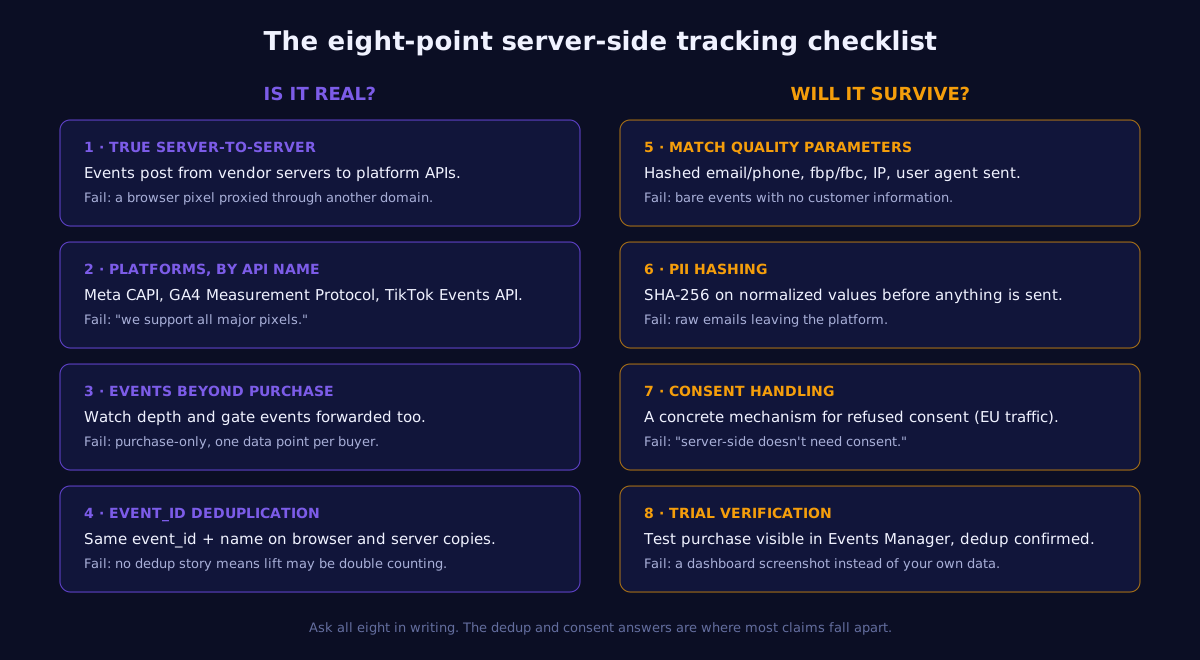
| # | Question for the vendor | The answer you want |
|---|---|---|
| 1 | Is this true server-to-server, or a pixel proxied through your domain? | Events post from their servers to platform APIs; a proxy alone is not S2S |
| 2 | Which platforms, by API name? | Meta CAPI, GA4 Measurement Protocol, TikTok Events API - named, not "all major pixels" |
| 3 | Which events - purchases only, or engagement too? | Watch-depth and gate events forwarded as well, so the optimizer sees video behavior |
| 4 | How is deduplication handled? | Same event_id and event name on browser and server copies, per Meta and TikTok dedup docs |
| 5 | Which match parameters do you send? | Hashed email/phone where captured, plus fbp/fbc, IP, user agent - the EMQ inputs |
| 6 | How is PII handled? | SHA-256 hashing of normalized values before send, per Meta's requirements |
| 7 | What happens when an EU viewer refuses consent? | A concrete answer; "server-side doesn't need consent" is wrong under EDPB guidance |
| 8 | How do I see it working in a trial? | A test-purchase walkthrough ending in Events Manager, not a dashboard screenshot |
Expanding the four that kill most deals:
True S2S vs. the proxy (question 1). A first-party proxy - the pixel script served from the vendor's or your own subdomain - genuinely helps against some blocking, and honest vendors sell it as what it is. But it still runs in the browser. If the browser never executes it, nothing fires. The tell on a demo call: ask what happens to the purchase event when the viewer's ad blocker stops every script on the page. True S2S answers "the server still sends it." A proxy answers with a subject change.
Events beyond purchase (question 3). Meta's CAPI accepts website events generally, not just purchases. For a VSL funnel, the valuable extra signal is engagement: who hit 50% watch depth, who passed the play gate, who reached the pitch. A platform that forwards only the purchase event gives the optimizer one data point per buyer. One that forwards engagement events gives it a gradient to climb.
Deduplication (question 4). Both browser and server will often see the same conversion, and that's the design. Meta deduplicates events that share an event name and event_id, keeping the first to arrive; TikTok's Events API documents the same event_id mechanism. TikTok's own published numbers make the case for running both channels: advertisers using Pixel and Events API together saw 19% more events captured and a 15% improvement in cost per action, per TikTok's 2023 announcement. No event_id, no dedup; no dedup, and your "lift" is partly double counting.
Consent (question 7). The European Data Protection Board's guidelines on the ePrivacy Directive, finalized in 2024, explicitly extend consent-style obligations beyond cookies to tracking pixels and unique identifiers. Moving the event to a server does not move it out of scope. What you want from a vendor is not a legal opinion - it's a mechanism: what gets sent, and what doesn't, when consent is refused.
Which vendor claims should make you skeptical?
Four phrases: "no pixel needed" (Google says the Measurement Protocol is meant to augment tagging, not replace it), "100% tracking accuracy" (nothing is), any lift claim from a vendor who can't explain dedup (the lift may be double counting), and silence on consent (EU traffic doesn't become invisible to regulators because the event moved server-side).
"No pixel needed" deserves its own paragraph because it sounds like a feature. Google's GA4 documentation states the Measurement Protocol's intent is "to augment automatic collection through gtag, Tag Manager, and Google Analytics for Firebase, not to replace it," and that MP-only collection may produce partial reporting. Meta's dedup design assumes both channels exist and prefers the browser event when both arrive within minutes. Server-side is the safety net and the recovery channel, not a replacement religion. A vendor pitching pixel-free tracking is pitching against the platforms' own documentation.
And the performance-claim sniff test: Meta's most-cited number is a 13% improvement in cost per result from a 2022 Meta study of advertisers who added CAPI. That's the platform's own headline figure. A vendor promising you 40% more conversions "from switching on server-side" is either measuring double counting or measuring a funnel that was badly broken before - worth knowing which before you write the case study into your projections.
How do you verify it during a trial?
One test purchase, fifteen minutes, three checks in Meta Events Manager: the event arrived via the Conversions API channel, it deduplicated against the pixel copy instead of double counting, and the Event Match Quality score reflects the customer parameters the vendor claims to send. Everything a vendor says lives or dies in this quarter hour.
The sequence:
- Set up like production. Real pixel ID, real CAPI token, the player embedded on a page that matches your funnel. Sandbox setups hide integration gaps.
- Buy through the funnel with an ad blocker enabled on the browser. This simulates your invisible cohort.
- Open Events Manager. The purchase should appear with the server channel listed as its source even though the browser pixel was blocked. That single row is the entire product working.
- Repeat without the ad blocker. Now both channels fire; confirm the event count is still one. That's dedup working.
- Check the match quality panel. If the vendor claims they forward hashed emails from play gates, the parameter list on the event should show it.
Never buy tracking from a screenshot. Buy it from your own Events Manager, on a test purchase you made with an ad blocker on.
If you run funnels for clients rather than for yourself, weight question 8 double and add a ninth: does per-client configuration exist, so each client's events reach their own ad account? That's the difference between a tool and an agency stack - the multi-client version of this setup is covered on our agencies page.
Frequently asked questions
Run the checklist against us
Server-side forwarding to Meta CAPI, GA4, and TikTok with event dedup, engagement events included. Try any plan for $1 and make the test purchase yourself.
Start your $1 trial →