Direct Response Video Player vs. Standard Video Hosting
A founder I talked to last year was spending $38,000 a month on Meta traffic to a 32-minute VSL hosted on a YouTube unlisted embed. The funnel converted, barely, and every optimization conversation was a guess. Then a viewer paused the video at minute 14 and the player did what YouTube's player does on pause: it laid a grid of suggested videos over the frame, including one of his own older videos with a different offer and a competitor's review of his product. His checkout page was one click away. So was everything else on the internet.
That's not a bug. YouTube's player is doing exactly what it was built to do: maximize time on YouTube. The problem is that a VSL is not trying to maximize time on YouTube. It's trying to walk one stranger to one buy button, once. Those are different jobs, and they need different machines.
A direct response video player is built for videos that exist to sell: muted-start autoplay handled cleanly, no third-party branding or suggested videos, resume play for returning visitors, CTAs and gates on a timeline you control, per-second retention tied to revenue, and server-side conversion forwarding. Entertainment-grade hosting optimizes for watch time and the next video - and its player decisions actively leak VSL conversions.
What is a direct response video player?
A player whose every default serves a sale rather than a session. That means it starts reliably under 2026 autoplay rules, keeps the viewer inside your funnel with zero foreign UI, controls when the buy button appears, remembers where a returning viewer stopped, and reports what each second of video is worth in revenue - not just in watch time.
The category exists because the incentives of mainstream video platforms point away from your checkout. An entertainment platform wins when the viewer watches another video. A B2B video marketing suite wins when your team publishes more videos and captures more leads into its CRM integrations. A direct response player wins only when the video sells. Every design decision follows from whose win condition the software serves.
An entertainment-grade player is optimized to start the next video. A direct response player is optimized to finish this one.
"Direct response" is not a size or a budget. It's a shape of funnel: paid or organic traffic to a page whose only job is a decision, usually with a video sales letter doing the persuading. If that describes your page, the player is not a commodity component. It is the single piece of software standing between your script and your revenue.
What breaks when you run a VSL on an entertainment-grade host?
Four things, in order of damage: the player promotes exits (related videos, branding, recommendations), autoplay behaves unpredictably across browsers, analytics stop at engagement instead of revenue, and there is no server-side path for conversion events - so your ad platform never sees a large share of the sales the video produced.
The exit-promotion problem. YouTube's own developer documentation is plain about this: since September 2018, setting rel=0 on an embed no longer hides related videos - it only limits them to videos from the same channel. And in August 2023 Google deprecated the modestbranding parameter entirely, so there is no supported way to remove YouTube's branding from an embedded player. Pause screens and end screens on your sales page become doorways out of your funnel, decorated with someone else's logo.
The autoplay lottery. Chrome's autoplay policy allows muted autoplay always, but sound requires a prior user interaction with the site or a high Media Engagement Index - a per-user score most cold traffic will never have. iOS Safari requires playsinline and a muted track, pauses the video if it ever unmutes without a user gesture, and WebKit disables silent-video autoplay entirely when the phone is in Low Power Mode. A generic embed treats all of this as someone else's problem. A DR player treats the muted first frame as the design constraint it is: a poster state, a designed unmute interaction, and a hook that works with captions on. (Deeper dive on the numbers side in our launch metrics guide.)
The page-weight tax. Google's web.dev guidance notes that popular embeds can ship over 100 KB of JavaScript - sometimes up to 2 MB - and that lazy-loading a YouTube embed saves roughly 500 KB on initial page load. On a paid-traffic landing page, that's your Core Web Vitals and your cost per click quietly absorbing the weight of features you didn't want.
The plan-gate problem. On Vimeo, hiding the Vimeo logo and controlling the player UI are paid-plan features, bandwidth on standard self-serve tiers is capped (2 TB per month per Vimeo's bandwidth policy), and the platform has been mid-restructure since Bending Spoons acquired it in late 2025 - entry-tier customization and pricing have been moving targets since. None of that is evil. It's just a product roadmap that doesn't answer to your funnel.
To be fair about the third player in this conversation: Wistia is a genuinely good B2B marketing video platform. Its Turnstile email gate is a real conversion tool, it ships resumable playback, and its engagement analytics are solid. If your videos live in a content library and feed a nurture sequence, Wistia is built for exactly that. The gap is downstream: its analytics model is engagement and lead capture, not revenue per viewer on a single high-stakes video with paid traffic behind it.
What makes video hosting "conversion focused"?
Five capabilities, and they have to exist together: a distraction-free player you fully control, autoplay handling designed for the muted-start reality, conversion controls (play gates, timed CTAs, resume play), revenue-tied per-second analytics, and server-side event forwarding to Meta, GA4, and TikTok.
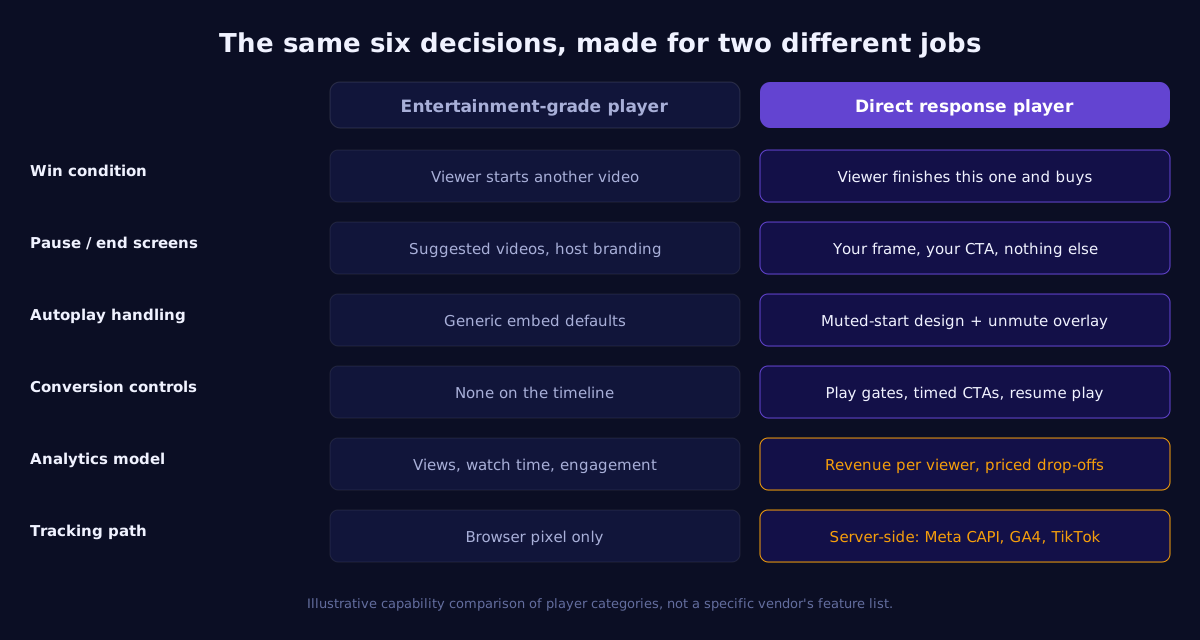
Walking the five:
- A player that carries only your intent. No suggested videos, no host branding, no links that leave the page. The pause screen shows your frame, not a menu.
- Muted-start design. Autoplay muted with a deliberate unmute overlay, captions as a first-class citizen, and a poster state for the Low Power Mode visitor. The player should make the browser rules work for the funnel instead of hoping they don't apply.
- Conversion controls on the timeline. Play gates that capture an email mid-video when they earn it, buy buttons that appear at the moment the offer lands, and resume play so the viewer who left at minute 18 starts at minute 18 tomorrow instead of bouncing off a restart.
- Revenue-tied analytics. Not "average view duration" - revenue per viewer, retention curves with the drop-off cliffs priced in dollars, and the watch depth your actual buyers reached. Engagement graphs tell you what viewers did. A DR player tells you what it cost.
- Server-side tracking. Ad blockers are used by roughly 29.5% of internet users per DataReportal's Q2 2025 data, and Safari's tracking prevention caps client-side cookies at seven days. A conversion-focused host forwards purchase and engagement events server-side so the ad platform's optimizer sees what actually happened. The mechanics are in our server-side pixel forwarding guide.
If the player was built for watch time, it was not built for checkout.
How is the analytics model different from standard host analytics?
Standard hosts measure attention; a direct response player measures money. YouTube Studio, Vimeo, and Wistia all publish retention and engagement graphs, but their published analytics describe watch behavior - none of their documentation describes tying per-second retention to order value or forwarding conversions server-side to ad platforms.
This is the difference that shows up in decisions. Take an invented but typical case: the engagement graph shows 40% of viewers leaving by minute 6. Only a revenue-tied model can tell you whether that matters. If your buyers cluster at minute 22 and the minute-6 leavers convert at near zero anyway, the cliff is cosmetic. If the viewers who watch past minute 6 are worth several times the ones who don't, the cliff is the most expensive six seconds in your business. Same graph, opposite priorities - and only one of them was worth your edit budget.
The test I give people evaluating any host: open its analytics and try to answer "which second of this video is costing me the most revenue?" If the interface has no concept of revenue, you have an engagement tool. Useful, but not for this.
Which capabilities should you check before hosting a VSL?
Run the seven-row checklist below against any host you're considering. Every "no" is a leak you will pay for in either conversions or workarounds - and the analytics and tracking rows are the ones that quietly decide whether your ad account can optimize at all.
| Capability | Why it matters for DR | Entertainment-grade host |
|---|---|---|
| Zero foreign UI (no related videos, no host branding) | Pause and end screens stop promoting exits | No (YouTube), partial and plan-gated (Vimeo) |
| Muted-start autoplay design | Cold traffic actually sees the hook | Generic embed behavior, no unmute design |
| Resume play | Long VSLs get finished across sessions | Varies by host |
| Play gates and timed CTAs | The offer appears when the script earns it | Email gates on some B2B suites, not timeline CTAs |
| Revenue per viewer analytics | Edit decisions priced in dollars, not minutes | No - engagement metrics only |
| Server-side event forwarding (Meta CAPI, GA4, TikTok) | Ad platforms see conversions pixels miss | Not described in any of their docs |
| Lightweight embed | Paid-traffic pages keep their Core Web Vitals | Embeds can run to 2 MB of JavaScript (web.dev) |
One honest caveat on the third column: these platforms are not badly built. They are precisely built - for a different job. Judging YouTube's player for leaking VSL conversions is like judging a city bus for losing a drag race. The mistake isn't the bus. It's entering it in the race.
If you want to see how specific dedicated players stack up against each other rather than against the entertainment tier, the head-to-heads live on our Vimeo comparison and the rest of the comparison library.
Frequently asked questions
Put your VSL on a player built for the sale
Distraction-free player, play gates, revenue-tied retention curves, and server-side pixel forwarding in one embed. Try any plan for $1.
Start your $1 trial →