How Long Should a VSL Be? What the Data Actually Says
I've watched this argument run for a decade. One camp swears by the 45-minute epic because that's what built the supplement and finance empires. The other camp says nobody watches anything longer than a TikTok anymore and your VSL should be four minutes with captions. Both camps quote "data." Neither camp's data is about VSLs.
Here's the uncomfortable fact I ran into while researching this piece: as of July 2026, there is no publicly available dataset that breaks down VSL conversion by length. Not one. The platform studies people cite measure business video in general. The one company sitting on a genuinely VSL-specific dataset keeps it gated behind an opt-in. So every confident number you've read on this question is either borrowed from a different context or made up. What follows is the honest version: what the proxy data really shows, how the practitioner consensus actually moved, and the method that makes the question answer itself.
There is no universal VSL length and no public VSL-specific data to derive one. Working ranges in 2026 practice: 8-20 minutes for cold paid traffic to mid-ticket offers, 20-45+ for high-ticket or complex mechanisms and presold audiences, under 5 for retargeting. The durable rule: length is an output of the sale your script has to make, corrected by your own retention and buyer watch-depth data - not a number you choose up front.
What does the actual data say about video length?
The proxy data all points the same direction: completion falls as length rises. Vidyard's benchmark of 943,305 business videos found 65% of viewers finish videos under a minute versus roughly 20% for videos over 20 minutes. Wistia's 13-million-video dataset shows an 11% engagement drop once videos cross the 30-minute mark. Neither dataset is about VSLs.
That last sentence is the part everyone skips. Wistia's 2026 State of Video report is built on more than 13 million videos - explainers, demos, webinars, training - and it says short videos average dramatically higher engagement (52% for videos under a minute) while positioning the 5-to-30-minute band as the home of conversion and nurture content. Vidyard's report says the same thing in retention terms, and adds a twist: businesses created 420% more 20-plus-minute videos year over year even though completion falls with length. Long video is growing in supply while engagement-per-minute shrinks. None of it distinguishes a sales letter from a product tour.
Even inside the general data there's a counter-current worth knowing: Wistia found webinar replays of 31 to 45 minutes out-engaged those under 30 minutes by more than 2x, and a longer video with lower engagement still often accumulates more total watch time than a short one with a great rate. Length punishes casual attention and rewards committed attention. A VSL's whole job is converting the first kind into the second.
Every article quoting "VSL conversion by length" numbers is quoting general video statistics wearing a VSL costume.
The only VSL-specific dataset of scale that exists - Vidalytics' State of VSL, built from roughly 200,000+ VSLs and billions in tracked revenue - is not publicly published; the headline dataset size is on the marketing page and the length breakdowns live behind the gate. Which means if you want VSL-length truth, you have exactly one reliable source: your own funnel. More on that in the last section.
Why did the 45-minute default change?
Because the environment the long VSL was built for changed underneath it. The 2012-2022 default of 45-80 minutes (ClickBank's own guidance in 2020: "the most successful VSLs that I have seen range from 45-80 minutes") assumed sound-on autoplay, patient attention, and cheap reach. Muted-start browser rules, short-form conditioning, and rising traffic costs broke all three assumptions for cold audiences.
A quick history, with the claims labeled. Jon Benson is widely credited in direct-response circles with inventing the text-on-screen VSL around 2007 - a credit that traces back to Benson himself, so treat it as industry lore rather than settled history. What's not in dispute is that the format his era produced ran long: the canonical examples were 45 minutes to well over an hour, and the most-watched financial VSL ever made, Stansberry's "The End of America," ran 77 minutes. That generation of VSL was built for a viewer who clicked a link, got audio instantly, and had nowhere better to be.
The 2026 viewer arrives from a paid social click, muted by the browser, thumb still hovering, having consumed short-form video for years (US TikTok users average 52 minutes a day on the app per eMarketer, though notably that figure fell 6.9% year over year - even short-form attention is contested now). Practitioners moved with the audience: Rob Palmer's February 2026 state-of-VSL piece argues 8-to-20-minute VSLs now outperform their longer counterparts for cold social traffic, with the 45-to-60-minute format surviving for presold audiences, high tickets, and complex mechanisms. His improvement numbers are unaudited, so take the direction, not the decimals.
Notice what did NOT happen: long VSLs didn't die. They got repositioned, from the default to a specialist tool. The mistake is running a 2015 default against a 2026 audience, in either direction.
How do you pick the right length for your offer?
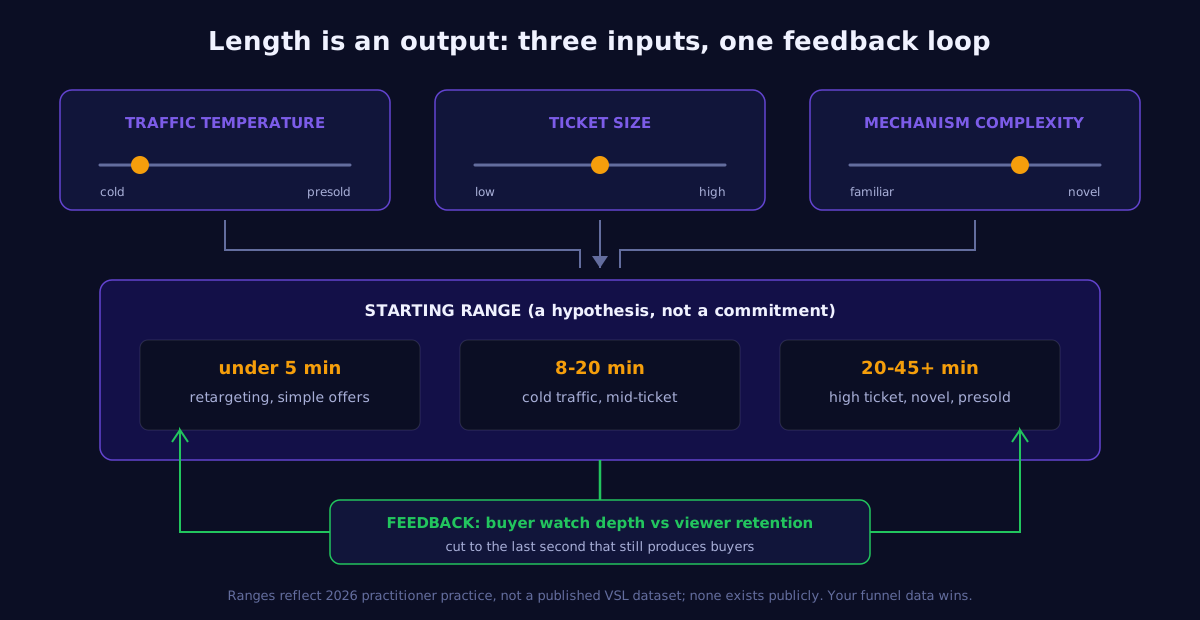
Three inputs set the starting length: traffic temperature, ticket size, and mechanism complexity. Cold traffic pushes shorter, high tickets and unfamiliar mechanisms push longer, and the combination locates your starting range. That starting range is a hypothesis for your data to correct, not a commitment.
| Situation | Starting range | Why |
|---|---|---|
| Retargeting, simple or known offer | Under 5 minutes | Trust exists; the sale is a reminder, not a persuasion project |
| Cold paid traffic, low-to-mid ticket | 8-20 minutes | Enough runway for problem, mechanism, and proof; short enough to survive muted-start attention |
| Cold traffic, high ticket or novel mechanism | 20-45 minutes | Unfamiliar claims need story and proof stacking; buyers self-select by watching |
| Presold audience (email list, webinar registrants) | 30-60+ minutes | Committed attention rewards depth; the webinar-replay data pattern lives here |
Two honest footnotes to that table. First, the mainstream SERP consensus for this query clusters around 5-20 minutes scaled by ticket price, and for once the consensus is roughly right about the middle of the market - it just presents guesses as data. Second, the extremes are real: AWAI, one of the older copywriting authorities, flatly refuses to give a number ("there isn't a rule"), and they're correct in the way that's least useful to someone who has to ship on Thursday. The table is a starting range; the next section is how you stop guessing.
How do you let your own data set the length?
Script the complete sale, publish it, then read two curves against each other: viewer retention and buyer watch depth. The last second that still produces buyers is your real length. Everything after it is production cost and drop-off risk with no revenue attached.
This is the part no benchmark can do for you, and it's mercifully mechanical:
- Write the sale, not the runtime. Script every section the offer genuinely needs - hook, problem, mechanism, proof, offer, objections, close. If that comes out at 14 minutes, you have a 14-minute VSL. If it's 38, you have a 38-minute hypothesis. (The section-by-section build is in our VSL script template.)
- Survive the first 30 seconds first. Length debates are irrelevant if the hook leaks. Our launch metrics guide benchmark: 60-75% of starters still present at second 30 for paid traffic. Below that, fix the hook before touching length.
- Read buyer watch depth, not average retention. Average retention tells you where the audience left. Buyer watch depth tells you the last second your revenue actually needed. When buyers cluster at minute 19 of a 34-minute video, minutes 20-34 are serving a small minority - test a cut and watch revenue per viewer, not completion rate.
- Cut at cliffs, not at averages. A heatmap shows whether a long section is boring (steady bleed) or broken (cliff). Cut broken before cutting long.
Length is an output, not an input: the sale sets the first cut, the buyer curve sets the final one.
Run that loop twice and the "how long should a VSL be" question dissolves into a number specific to your offer - which is the only version of the answer worth having. It's also, not coincidentally, a loop you can only run on a player that ties watch depth to revenue; the capability checklist for that lives in our best VSL platforms list.
Frequently asked questions
Let your buyers set the length
Per-second retention plus buyer watch depth tied to revenue: the two curves that turn the length debate into a decision. Try any plan for $1.
Start your $1 trial →